
WE is reversible if treated with a timely and adequate dose of parenteral thiamine. If it is undiagnosed, or treated with inadequate dosages of thiamine, it is likely to proceed to the chronic state, Wernicke-Korsakoff’s Syndrome (‘inadequate’ dosages are explained below in the treatments section). The challenge with WKS is to prevent the patient developing the syndrome in the first place, but if this fails, to manage WKS so as to improve brain function and to aid the patient to adapt to their cognitive impairment, suggesting that the cognitive deficits are irreversible in cases that have progressed too far; how far is too far remains unclear. The general method of diagnosis is the use of Magnetic Resonance Imaging (MRI) to identify brain damage detailed in the ‘Causes’ section should patients be showing an anterograde amnesia, as well as possessive a history of poor nutrition and alcoholism.
As mentioned, sometimes patients have already sustained irreversible brain damage at the time of presentation (Thomson, Guerrini, & Marshall, 2012). The accumulated damage, from thiamine deficiency and alcohol misuse, is likely to render the use of oral thiamine therapeutically inadequate since the body is unable to produce high enough concentrations of thiamine in the blood to traverse the blood–brain barrier.
Hodges & Warlow (1990) identified very clear criteria that must be met for an accurate diagnosis of TGA. These are listed below in Figure 7.
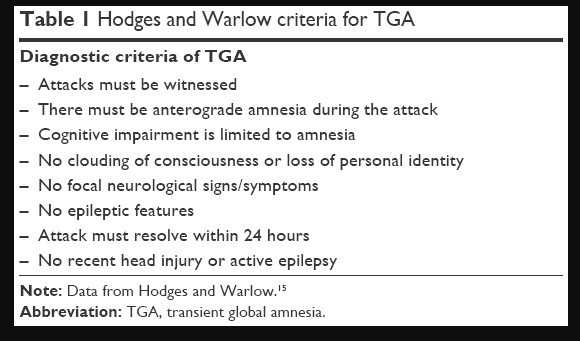
The above criteria are critical because other disorders, such as Transient Epileptic Amnesia (TEA) and Transient Ischemic Attack (TIA) may involve similar episodes but whilst similar they are indeed definitively different. Furthermore, the requirement for strict diagnostics is further emphasised by the fact that TGA does not typically show acute changes when using brain imagining techniques, apart from T2-hyperintense punctate lesions in lateral hippocampal regions (Faust & Nemes, 2010). Thus, these techniques cannot be relied upon to aid a diagnosis as is the case with other disorders of amnesia.
The good news when examining TGA is that it is believed to be relatively benign leaving no residual damage following episodes and as earlier mentioned, without long-term conditions/deficits resulting from an episode (Portaro, et al., 2018). It is also worth noting that individuals do not often experience repeat episodes.

 Neuropsychology